
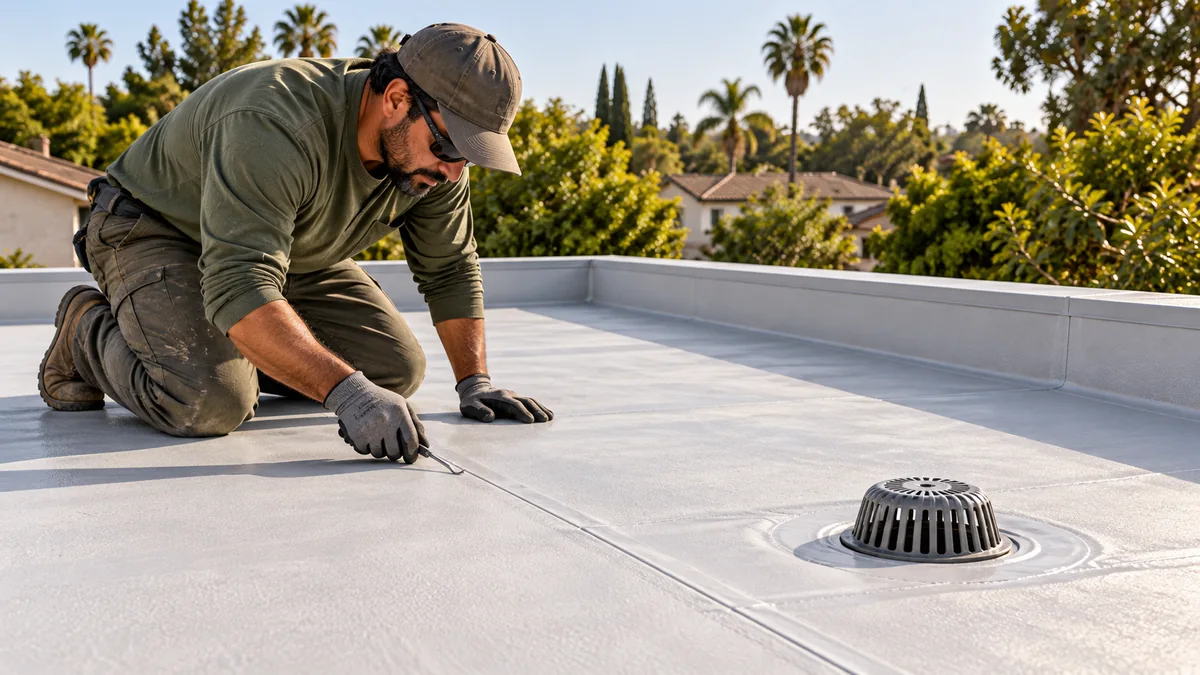
Start with drainage and the existing system
Low-slope roofs are designed around a particular covering and water-management approach. Blocked outlets, damaged seams, penetrations, and edge details may contribute to leaks. Water that remains after rainfall is a reason to review drainage conditions, not simply cover the surface again.
Tell us where water collects, how long you have noticed it, and whether maintenance or equipment work occurred before the leak began. Photos taken safely can help explain the issue. The recommendation should address the cause of the problem and identify any limits to a local repair.
The material must suit the assembly
Single-ply membranes and asphalt-based low-slope systems have different installation and repair methods. The appropriate choice depends on the roof's slope, deck, existing layers, drainage, equipment, use, and project requirements. A material name alone is not enough to compare proposals.
Ask how the new work connects at walls, edges, drains, scuppers, curbs, and roof penetrations. If the building has both pitched and low-slope sections, those connections need to be part of the scope rather than left between separate estimates.
- Existing covering and the condition beneath it
- Drain locations and roof drainage details
- Seams, edges, walls, and penetrations
- Equipment access and coordination with other trades
- Removal, substrate preparation, and proposed roof system
Repair, coating, or replacement? Ask what each addresses
A defined repair may make sense for an isolated defect. A coating may be an option for a suitable existing assembly, but compatibility, surface preparation, moisture conditions, and drainage still matter. A coating should not be treated as a universal fix for damaged or wet roofing.
When replacement is recommended, ask what findings rule out a smaller scope. When a repair or coating is proposed, ask what remains underneath and how the roof will be maintained afterward. The choice should be supported by the roof's condition, not just by the lowest initial price.
Coordinate work around the people using the building
A house addition, apartment building, and commercial property bring different access needs. Let us know about tenants, operating hours, roof-mounted equipment, parking, deliveries, and areas that must remain accessible. A work plan should identify the people responsible for equipment movement or other trades.
Confirm who can approve work, how concealed damage will be handled, and who receives progress information. If temporary protection is needed, discuss safe access and weather conditions. Any proposed schedule should account for the actual scope and approvals.
Request a low-slope roofing estimate
EverStrong Roofing is based at 6041 Simpson Ave in North Hollywood. Call (747) 946-7850 with your address, building type, roof material if known, and a description of the issue. Share any prior estimates or roof paperwork you have. That gives us a useful starting point for discussing repair, replacement, and the details that should appear in your written scope.
Questions about flat roofing
Can you patch a low-slope roof instead of replacing it?
A patch may be suitable when the defect is limited and the existing system can accept a compatible repair. Wider damage, repeated failures, or concealed moisture may change the recommendation. Ask what the repair addresses and which conditions remain outside its scope.
Will a roof coating stop every leak?
No. Coatings depend on a suitable existing system, correct preparation, and compatible details. Drainage defects, wet materials, and damaged components may need other work. Ask why a coating is appropriate for the specific roof before comparing its price with replacement.
What should a flat roof estimate include?
Look for the proposed system, removal or preparation work, drainage details, flashing, penetrations, equipment coordination, concealed-damage allowances, and written warranty terms. The estimate should state exclusions so separate work does not become a surprise later.